

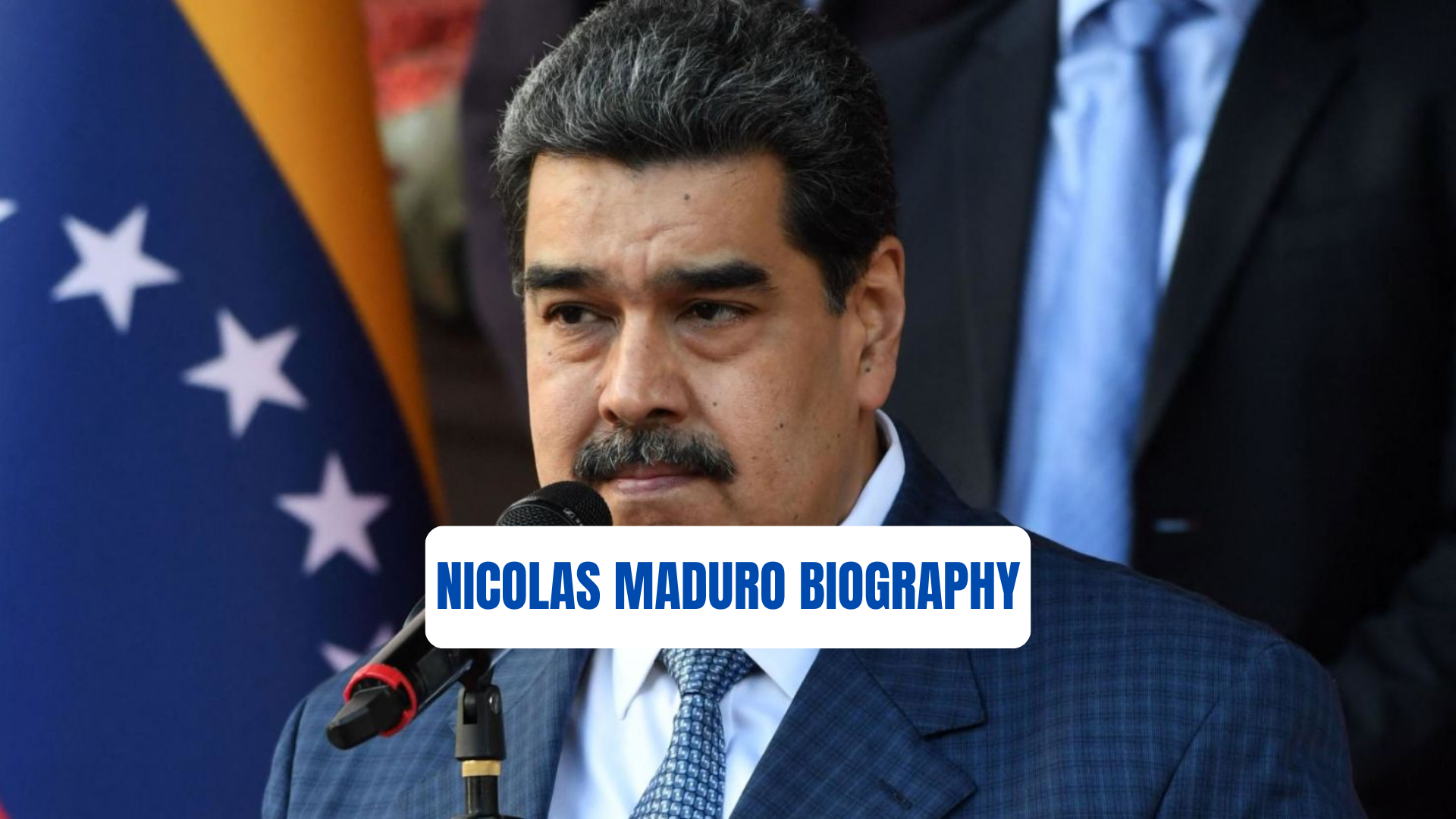
Nicolás Maduro is one of the most influential and controversial political figures in modern Latin American history. As the President of Venezuela, his leadership has shaped the country’s political direction, economic structure, and international relations for more than a decade. Supporters view him as the guardian of the Bolivarian Revolution initiated by Hugo Chávez, while critics accuse his government of authoritarianism and economic mismanagement. This detailed biography of Nicolás Maduro explores his early life, political rise, presidency, ideology, controversies, and long-term legacy.
Early Life and Background
Nicolás Maduro Moros was born on November 23, 1962, in Caracas, Venezuela. He grew up in a working-class family, an experience that would later influence his political worldview and identification with socialist movements. Maduro did not come from Venezuela’s traditional political elite, which distinguished him from many past leaders.
As a young man, Maduro became involved in leftist politics and labor activism. He worked as a bus driver for the Caracas Metro system, a role that placed him in close contact with organized labor unions. His union involvement helped him develop leadership skills and deepened his commitment to socialist and anti-imperialist ideals. During this period, he became influenced by Marxist thought and Latin American revolutionary movements.
Maduro also spent time in Cuba during his early years, where he reportedly received political training. His exposure to Cuba’s socialist system played a key role in shaping his ideological alignment with Fidel Castro and later with Venezuela’s own socialist transformation under Hugo Chávez.
Entry into Politics
Nicolás Maduro’s formal political career began in the 1990s, a time of widespread dissatisfaction with Venezuela’s traditional political parties. He became associated with Hugo Chávez following Chávez’s release from prison after a failed coup attempt in 1992.
When Chávez was elected president in 1998, Maduro emerged as a loyal supporter of the Bolivarian Revolution. In 2000, he was elected to the National Assembly, where he quickly gained recognition for his strong oratory skills and unwavering loyalty to Chávez’s political project.
Maduro’s rise within the government was steady. He served as President of the National Assembly from 2005 to 2006, a position that solidified his status as one of Chávez’s most trusted allies. His ability to navigate internal party dynamics and maintain ideological discipline helped him stand out among other leaders in the ruling movement.
Role as Foreign Minister
In 2006, Hugo Chávez appointed Nicolás Maduro as Venezuela’s Minister of Foreign Affairs. This role significantly increased Maduro’s visibility on the global stage. As foreign minister, he was responsible for strengthening alliances with countries opposed to U.S. influence, including Cuba, Russia, China, Iran, and several Latin American nations.
Maduro became a key spokesperson for Venezuela’s anti-imperialist foreign policy. He defended Chávez’s vision of a multipolar world and promoted regional integration through organizations such as ALBA (Bolivarian Alliance for the Peoples of Our America). His tenure as foreign minister lasted until 2013 and laid the groundwork for his eventual succession.
Becoming President of Venezuela
In December 2012, as Hugo Chávez’s health deteriorated due to cancer, Chávez publicly named Nicolás Maduro as his chosen successor. This endorsement was critical in shaping Maduro’s political future.
Following Chávez’s death in March 2013, Venezuela held a presidential election. Nicolás Maduro won by a narrow margin against opposition candidate Henrique Capriles. His victory marked the beginning of a new era, but also one filled with political polarization and economic challenges.
Maduro presented himself as the protector of Chávez’s legacy, frequently invoking the late leader’s image and rhetoric. His presidency initially focused on continuity, maintaining socialist policies, state control over key industries, and expansive social programs.
Economic Challenges and Crisis
One of the defining aspects of Nicolás Maduro’s presidency has been Venezuela’s severe economic crisis. The country, heavily dependent on oil exports, faced declining oil prices starting in 2014. Combined with structural economic issues, sanctions, and policy decisions, this led to hyperinflation, shortages of basic goods, and mass emigration.
Maduro’s government implemented price controls, currency regulations, and increased state intervention in the economy. While intended to protect the poor, critics argue these measures worsened production declines and encouraged black markets.
The economic situation became a central point of criticism from both domestic opposition and international observers. Millions of Venezuelans left the country in search of better opportunities, creating one of the largest migration crises in recent history.
Political Controversies and Accusations
Nicolás Maduro’s presidency has been marked by intense political controversy. Opposition groups and several foreign governments accuse his administration of undermining democratic institutions, restricting press freedom, and using security forces to suppress dissent.
The 2018 presidential election, which Maduro won, was widely disputed. Several opposition parties boycotted the vote, and many countries refused to recognize the results. In 2019, opposition leader Juan Guaidó declared himself interim president, leading to a prolonged political standoff.
Maduro, however, retained control over key state institutions, including the military and Supreme Court. With support from allies such as Russia, China, and Cuba, he remained in power despite international pressure and sanctions.
Ideology and Leadership Style
Nicolás Maduro identifies as a socialist and continues to promote the ideology of Chavismo. His leadership style is centralized and heavily reliant on executive power. He frequently uses televised addresses to communicate directly with the public and frame political narratives.
Maduro emphasizes national sovereignty, resistance to foreign intervention, and loyalty to revolutionary ideals. Supporters argue that he has defended Venezuela against external threats, while critics claim his leadership has deepened authoritarian tendencies.
International Relations
Under Maduro, Venezuela’s international relations have shifted significantly. Ties with the United States and several European nations deteriorated, while relationships with Russia, China, Iran, and Turkey strengthened.
Maduro has used international alliances to secure financial assistance, military cooperation, and diplomatic backing. These relationships have helped his government survive periods of intense isolation but have also contributed to geopolitical tensions.
Personal Life
Nicolás Maduro is married to Cilia Flores, a prominent political figure who has served in various government roles. Often referred to as Venezuela’s “First Combatant,” Flores is considered highly influential within the ruling party.
Maduro is known for his strong admiration of Hugo Chávez and often references spiritual and symbolic elements in his speeches, which has become a distinctive feature of his public persona.
Legacy and Historical Impact
The legacy of Nicolás Maduro remains highly contested. To supporters, he represents resistance against imperialism and the continuation of socialist ideals. To critics, he symbolizes economic collapse, democratic backsliding, and humanitarian crisis.
Historians and political analysts continue to debate his long-term impact on Venezuela. His presidency will likely be remembered as one of the most consequential and polarizing periods in the nation’s history.
FAQs
Who is Nicolás Maduro?
Nicolás Maduro is the President of Venezuela and the political successor of Hugo Chávez.
When did Nicolás Maduro become president?
He became president in 2013 following Hugo Chávez’s death.
What is Nicolás Maduro’s political ideology?
He is a socialist and a strong supporter of Chavismo and anti-imperialist policies.
Why is Nicolás Maduro controversial?
He is criticized for economic mismanagement, alleged authoritarianism, and disputed elections.
Is Nicolás Maduro still president of Venezuela?
Yes, he remains in power despite domestic opposition and international criticism.
Conclusion
Nicolás Maduro’s biography reflects the complexity of modern Venezuelan politics. Rising from a working-class background to the presidency, his journey is deeply intertwined with Hugo Chávez’s revolutionary vision. Whether viewed as a defender of sovereignty or a symbol of national crisis, Maduro’s influence on Venezuela is undeniable. Understanding his life and leadership is essential to understanding Venezuela’s past, present, and possible future.